ANTHROPIC: THE $81.3 BILLION IPO, SEEN FROM THE RETAIL SEAT
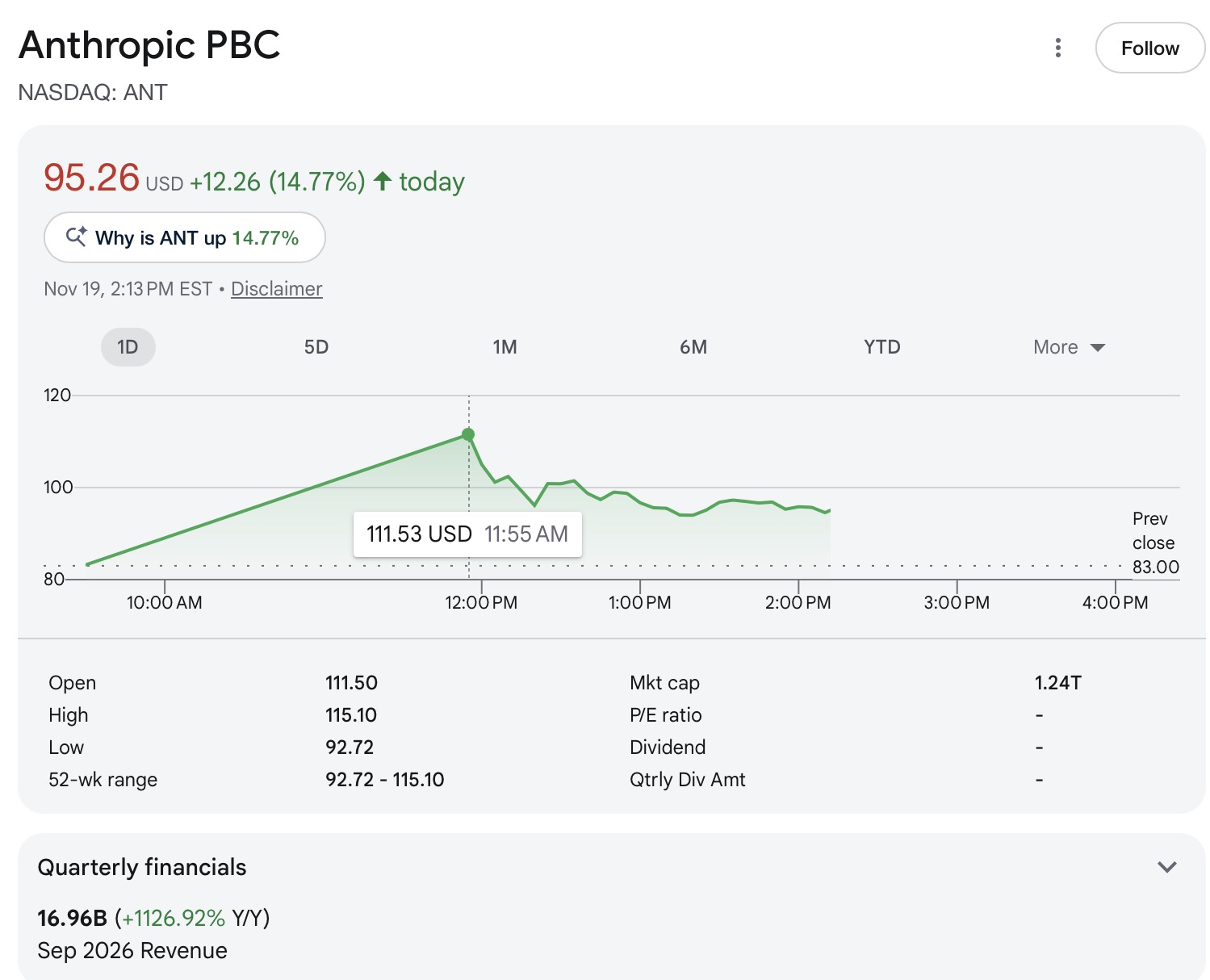
CHREMATISTICS AI IPO Watch · 11.19.26 VC · Equities · Retail Investor Anthropic Opens at $111.50, Gives Back More Than Half Its Pop by 2 PM: The $81.3 Billion IPO, Seen From the Retail Seat The largest listing in history made its IPO allocants 15% richer in an afternoon. Anyone who bought the first trade was down roughly the same amount. Here is what the day says about who gets access, who gets paid, and what a regular investor is actually buying. Chrematistics AI Editorial · Data as of 2:13 PM EST, November 19, 2026 Anthropic PBC (NASDAQ: ANT), first-day quote at 2:13 PM EST. The dotted line at $83.00 is the IPO price. Peak print on the chart: $111.53 at 11:55 AM. Source: Google Finance. $83.00 IPO price (range was $70–78) $111.50 First trade · +34% vs. IPO $95.26 2:13 PM · +14.77% vs. IPO $81.3B Raised · largest IPO ever 980M Class A shares sold ~6x Reported oversubscription 01 Two prices, two investors Every blockbuster IPO has two entry prices. One is the offering price, set the night before by the company and its banks and handed to the investors they choose. The other is the first trade on the exchange, which is where almost everyone else gets in. For Anthropic those two prices sat $28.50 apart. The company priced at $83 on Wednesday, above a marketed range of $70 to $78. When Nasdaq trading opened just before noon Eastern on Thursday, the first prints came in at $111.50 , about a third higher. The stock touched $115.10 , then slid. By 2:13 PM it was at $95.26 , having dipped as low as $92.72 along the way. That leaves the stock up 14.77% on the day if you measure from the IPO price, which is how the headline number is calculated. Measured from the first trade, it is down 14.6%. About 57% of the opening premium had already evaporated by early afternoon. Entry point Price paid $1,000 buys Worth at 2:13 PM Result IPO allocation $83.00 12.05 sh $1,148 +14.8% First trade $111.50 8.97 sh $854 −14.6% Intraday high $115.10 8.69 sh $828 −17.2% The gap between those rows is the oldest structural fact of the IPO market. In a heavily oversubscribed deal, the underwriters decide who receives shares at the offering price. University of Florida finance professor Jay Ritter, who has tracked IPO data for decades, has documented that investors know this and pad their orders on hot deals, expecting to be cut back. Retail investors are rarely at the front of that line. For most of them, the IPO began at $111.50. 02 The biggest listing ever, by the numbers Anthropic sold 980 million Class A shares at $83. Of those, 956.4 million were new shares issued by the company; the remaining 23.6 million came from existing stockholders cashing out. The banks also hold an option to sell up to 147 million more shares over the next 30 days, a standard overallotment that can add several billion dollars to the total. The proceeds of $81.3 billion beat the $75 billion SpaceX raised in June, which had itself set the record. SpaceX still holds the valuation crown: it listed at about $1.7 trillion, compared with a little over $1.5 trillion for Anthropic at its offering price, counting every share that could be issued. Market capitalization figures for the stock are inconsistent on day one, because providers count shares differently. Google Finance showed $1.24 trillion at midday. TechCrunch estimated that the opening print implied more than $2 trillion on a fully counted basis, which would place Anthropic behind only Apple, Amazon, Alphabet, Nvidia and Microsoft. For a retail investor, the fully diluted number is the one that matters, because future share issuance dilutes your stake. Combined with existing funding and private placements arranged around the listing, the company is expected to hold around $220 billion in cash. One analyst put it bluntly to TechCrunch: “Anthropic’s going to have more cash on hand than any company has ever had.” Analyst quoted by TechCrunch 03 What buyers are paying for The growth curve is the reason the book was oversubscribed. According to the company’s amended S-1 filing, third-quarter revenue was about $17 billion, roughly twelve times the same quarter a year earlier. Revenue for the first nine months of 2026 came to $33.2 billion. For all of 2025 it was $2.5 billion. In 2023 it was $41 million. The customer base is broadening as well as deepening. The number of customers spending more than $100,000 a year rose from about 1,500 in December 2025 to more than 11,900 by the end of September. Robinhood’s CFO, reviewing the prospectus, noted that a customer spending $10 million a year already ranks among Anthropic’s top 250, which he read as a sign of how much room remains above the current base. How the money comes in matters for anyone modelling the business. In the first half of the year, roughly 80% of revenue was consumption-based, billed by the token according to which model a customer uses, and about 20% came from subscriptions. Token pricing behaves more like a utility than a software licence: revenue rises and falls with usage, and usage rises when prices fall. Analysts expect token volume to become a headline metric for AI investors, the way subscriber counts were for streaming companies, though the figure remains opaque from the outside. Not all of the investors who praise the story are buying it. Pershing Square’s Bill Ackman called Anthropic “the most amazing business story of this century” Bill Ackman, at Yahoo Finance Invest but said he would not be a buyer, because he could not estimate its worth with enough confidence to fit a low-risk portfolio. 04 The other side of the ledger The same filing that shows the revenue curve also shows the bill. Anthropic lists about $895 billion in spending commitments, almost all of it for computing and data centers. Roughly $70 billion of that falls due within twelve months. At the end of September the company held about $132 billion in cash and short-term investments, so the total commitment is close to seven times its cash at that date, before the IPO proceeds arrived. Profitability has been brief. Anthropic posted its first operating profit, $974 million, in the second quarter, then swung to a $567 million operating loss in the third. Two items drove the swing. Demand outran the computing capacity the company had booked in advance, so it bought $5 billion of short-term compute that the filing says costs significantly more than its long-term contracts. It also recorded a $2 billion non-cash charge tied to its employee donation-matching program, discussed below. Seaport Research analyst Jay Goldberg had predicted, days before the filing, that profits would come and go as compute spending climbs. Credit markets are watching too. DoubleLine founder Jeffrey Gundlach said at Yahoo Finance Invest that he would not buy Anthropic bonds and argued the company does not merit the investment-grade rating it is seeking. One more disclosure landed in the final days before pricing. The amended prospectus reported that Anthropic had determined it crossed a threshold in its own Responsible Scaling Policy: the point where AI is accelerating the company’s research enough to roughly double the pace of model improvement. Crossing that line commits the company to tighter safeguards rather than a pause. The filing says the determination rests on projections about future models and the overall rate of progress rather than on behaviour observed in current ones. It is an unusual item to find in a risk-factor section, and buyers priced the deal anyway. 05 Who gets paid regardless The banks. Evercore ISI analyst Glenn Schorr estimated the underwriting fee pool at roughly $562 million. In his base case, co-leads Goldman Sachs and Morgan Stanley earn about $112 million each, while Bank of America, Citigroup and JPMorgan take about $84 million apiece. Twenty-two banks appear on the deal. These fees are earned at pricing; they do not depend on where the stock trades next month. The strategic backers. Amazon and Google will each hold more than 5% of the company, and TechCrunch reported this week that together they will own nearly 30%. Amazon has invested $18 billion so far, with up to $15 billion more available. As of September 30 it valued its holdings at $92.5 billion in nonvoting preferred stock, plus $146.2 billion in notes that convert to equity at the IPO. Google has committed up to $40 billion on top of roughly $3 billion invested earlier. Both companies are also Anthropic’s suppliers. Anthropic has agreed to spend about $200 billion on Google’s TPU chips over five years and more than $100 billion on Amazon Web Services over ten. Money flows from the cloud providers into Anthropic as investment and back to them as revenue. This is the arrangement critics call circular financing. It is legal and disclosed, but it means part of what looks like independent market validation comes from parties that profit on both sides. Charity. TechCrunch calculated that the listing could ultimately direct about $156 billion toward philanthropy. The company’s Public Benefit Fund holds 5% of shares, roughly 850 million, worth about $80 billion at today’s trading price, and earns a further 2% grant each time the valuation rises more than 50% above the IPO price; the next trigger would be about $124.50 a share. Employees have pledged shares to causes of their choosing, which the company matches at 3-to-1 for longer-tenured staff and 1-to-1 for newer hires, with more than 550 million shares reserved for that purpose. TechCrunch estimates $23 billion in employee pledges and about $53 billion in matches. The total equals roughly a quarter of what Americans gave to charity in 2025, though it depends on pledges being honoured and on how quickly donor-advised funds actually distribute the money. For a shareholder, the matching program is not only philanthropy. It is a line item. The $2 billion third-quarter charge shows that matched donations appear on the income statement, and newly delivered shares dilute existing holders. 06 Crypto priced it first On Wednesday, before the final price was set, traders on the decentralized exchange Hyperliquid were already trading pre-IPO derivatives on Anthropic. Crypto commentator Scott Melker pointed out that those contracts implied a share price around $96 and a first-day gain of 20 to 25%, while the official range still topped out at $78. The opening print overshot that estimate badly. The afternoon price has drifted back to within a dollar of it. Melker noted the same pattern with SpaceX in June. Whether the agreement is skill or coincidence, it shows something worth watching: a permissionless market, open to anyone with a wallet, produced a price signal for a pre-IPO company that the traditional allocation process kept closed to most retail investors. 07 What history says about day one This year has already produced two cautionary listings. SpaceX opened at $150 in June, $15 above its IPO price, and gained around 40% in its first week. By August it was nearly 30% below that first trade, and five months later it still has not recovered to it. Cerebras opened at nearly double its $185 IPO price in May; its first close remains its best, and the stock now trades at about half what IPO buyers paid. Ritter’s long-run data offers a framework. Among more than 4,000 IPOs since 1980 of companies with at least $100 million in sales, those priced at 20 to 40 times sales returned about 3% on average over three years from their first close. The cheapest group returned about 41%. Yahoo Finance calculated that at $78, Anthropic would trade at about 29 times trailing sales; at today’s $95 that multiple, by our extrapolation, is near 35. The partial consolation in Ritter’s data is that IPOs of the very largest companies, those with more than $1 billion in sales, have performed about in line with the market. Oversubscription is not a reliable signal either. Saudi Aramco drew about five times the shares on offer in 2019. Facebook and Rivian also had packed order books and were down roughly 40% to 70% a year after their first-day open. Several market veterans pointed to the period after the listing rather than the debut itself. Former Cisco CEO John Chambers said the steadiness of gains in the following weeks matters more than the opening number. Wealth manager Robert Schein said the market’s real verdict arrives after the lockup expires and early holders are free to sell. 08 Reading the signals Chrematistics AI does not ask whether a public statement is true. It asks what pattern the statement fits and who benefits if the audience acts on it. Applied to the past week, a few patterns stand out. The range moved up, then the price cleared the range. A $70–78 range followed by an $83 pricing is the classic way to tell the market that demand is strong. It also anchors the first-day gain against a number the issuer chose. The “line around the block” was widely publicized. Reports of multiple-times oversubscription circulated through the week. Because hot-deal orders are padded by design, oversubscription mainly tells you that allocations will be scarce. It says little about value. The parties with guaranteed returns are the loudest. Underwriters, cloud suppliers and pre-IPO holders all benefit from a strong debut regardless of the stock’s next three years. Their enthusiasm is rational, and that is exactly why it should not substitute for your own analysis. The concentration is the risk. Ariel Investments co-CEO Mellody Hobson observed that it is worrying when commentary implies an entire market of thousands of stocks will follow a single IPO. When one listing becomes the referendum on a whole sector, its volatility spreads into index funds and retirement accounts held by people who never placed an order. Good-money lens Anthropic, priced in sats Using the morning bitcoin quote of about $63,790, here is the day measured in the hardest money we track. Price point USD Sats per share IPO price $83.00 130,113 First trade $111.50 174,791 Intraday high $115.10 180,434 2:13 PM $95.26 149,332 At Google Finance’s $1.24 trillion market cap, Anthropic is worth about 19.4 million bitcoin, roughly the value of every coin in circulation at today’s price. A company founded in 2021 is now valued in the same order of magnitude as the entire supply of the asset that was designed to resist dilution, while the company itself is still issuing shares. Sats conversion uses a single BTC quote and does not track intraday bitcoin moves. 1 BTC = 100,000,000 sats. 09 The retail checklist Know your real entry price. The “+14.8%” headline belongs to allocants at $83. If you bought on the exchange today, your reference is $111.50 or wherever you filled. Use the fully diluted valuation. At the IPO price, counting every share that could be issued, the company was valued at over $1.5 trillion. Smaller market-cap figures understate what you are paying for. Watch the overallotment and the lockup. Up to 147 million extra shares can be sold within 30 days. When the lockup ends, early holders and employees can sell, which historically is when IPO prices find their level. Read the commitments, not just the revenue. $895 billion in spending obligations against roughly $132 billion in pre-IPO cash is the number that sets how much growth the company must sustain. Count the dilution sources. The overallotment, employee equity, the Public Benefit Fund’s step-up grants and donation matching all add shares over time. Size for concentration. If you already own index funds, you will own Anthropic once it enters them. A direct position on top of that doubles your exposure to a single name and a single theme. Bottom line Anthropic’s listing is a genuine financial milestone: the fastest revenue climb ever brought to public markets, the largest raise on record, and a philanthropic commitment without precedent. It is also a reminder of how the IPO market is built. The best price went to those with access. The fees went to those with the mandate. And the price that ordinary investors could actually reach had given back more than half its premium within two hours of the opening trade. Sources Anthropic hits NASDAQ exchanges at $111, 33% above IPO price — TechCrunch, Nov 19, 2026 Anthropic IPO live: Company prices stock at $83, set to begin trading Thursday — Yahoo Finance live coverage, Nov 18–19, 2026 Anthropic’s IPO could deliver $156 billion to charity — TechCrunch, Nov 19, 2026 Google Finance quote for ANT, Nov 19, 2026, 2:13 PM EST (screenshot above) Prices are intraday and will change. Return calculations exclude fees and taxes. Sats and multiple calculations are Chrematistics AI estimates. This article is for information and education only and is not investment advice; Chrematistics AI is not a licensed financial adviser.